
The History of Game Sound
Date       : 2025-12-11
Entry ID   : 17690
Entry type : comment
The History of Game Sound
Contents:
- The History of Game Sound
- Changelog
- References
The History of Game Sound
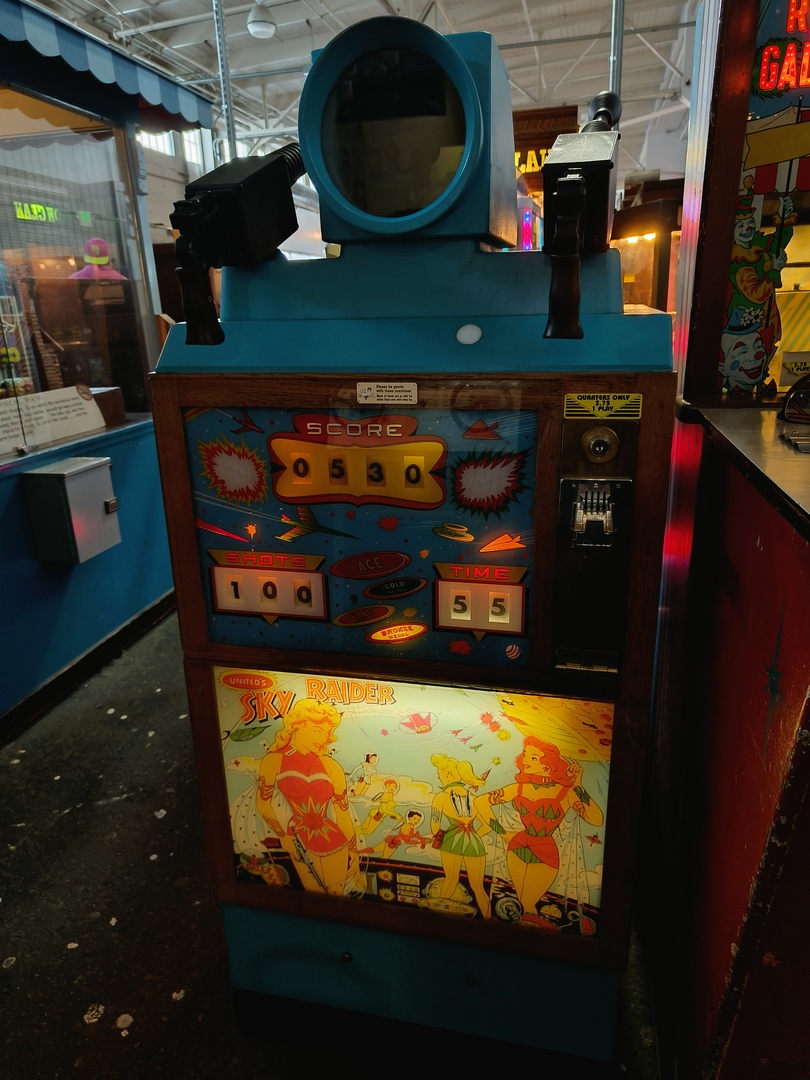
Photo from Musée Mécanique in San Fransisco 2024
From the earliest pinball and electro-mechanical arcade games, the ability to play sounds as a means of attracting and entertaining players in noisy arcades and bars was important.
Games such as the twin gun air fighter game Sky Raider from 1958, a game I tried myself in 2024. This electro-mechanical arcade game had mechanical shooting sounds for machine guns and a physical bell for when you got points 1. These two sounds had different functions, one was a simulation of a real machine gun sound immersing you in the illusion of the game world, and the other was a feature related to the rules of the gameplay, giving you feedback on your hits and communicating that your points were racking up.
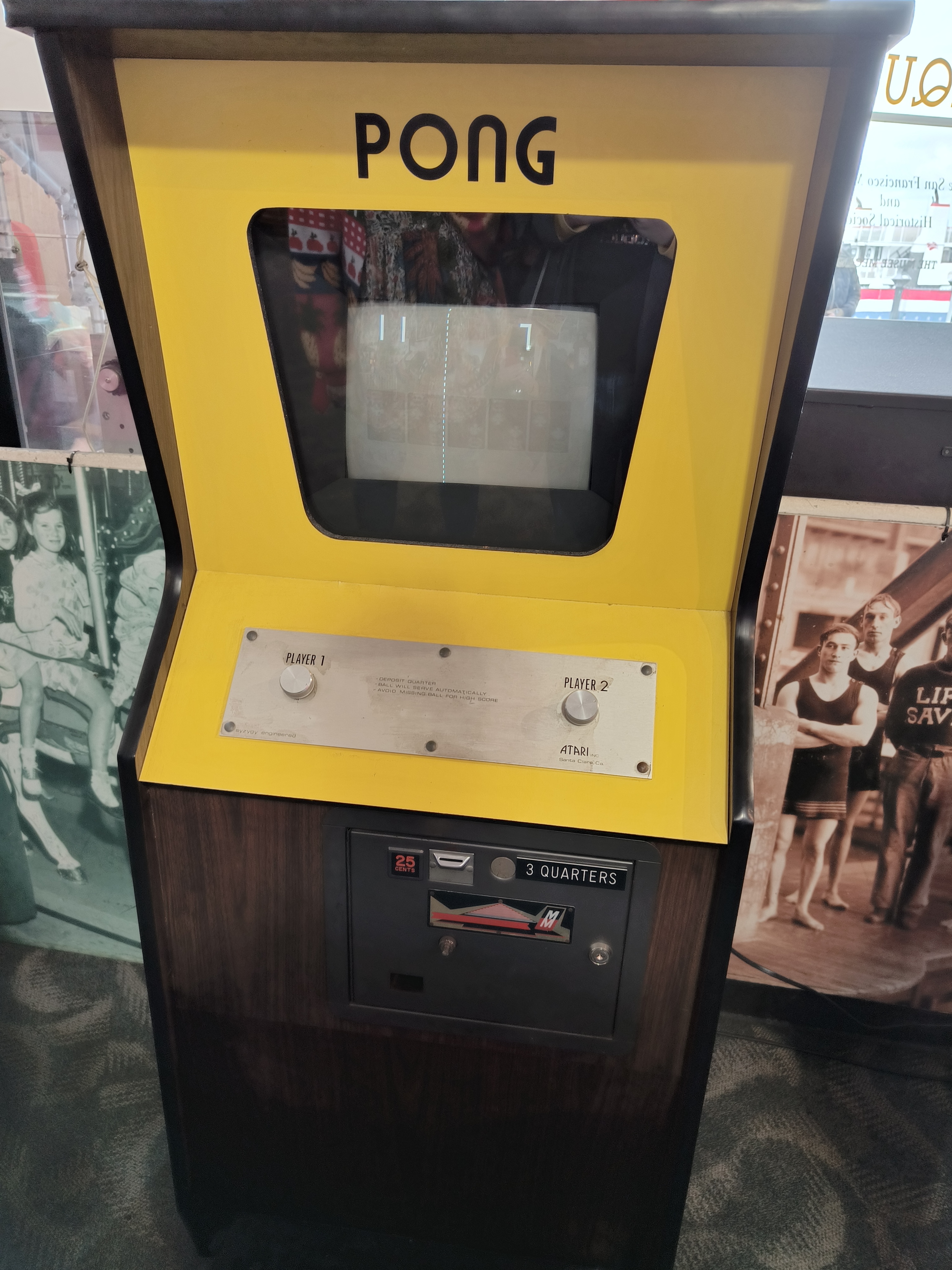
In the 1970s, video arcade games would start to gain popularity over the old electro-mechanical games, and the complexity of the electronics would grow along with the requirements of the games that were competing for attention in the arcade halls. The games from before the 1970s often produced sound the same way as pinball machines, using bells and other percussive mechanical sounds, controlled by discrete digital logic, meaning digital machines built from discrete components, with no processor chips.
From the 1970s and into the early 1980s, we would see a variety of new approaches to sound, including custom discrete logic controlling analog oscillators, CPU-based realtime synthesis, dedicated audio chips, voice synthesis, and even magnetic tape playback. It was rare that arcade machines shared hardware configurations, so audio capabilities would vary a lot from game to game. This would change during the 1980s, where standard sound chips started to become more widespread.
In the homes of the early 1970s, the first generations of game consoles and home computers appeared, bringing types of games previously only seen in arcades or in university labs home for kids to play on their living room TVs. 2 However, for the first couple of decades, the arcade games would stay technologically ahead of the home video game hardware, although home consoles and computers would gradually catch up.
Many of the technologial concepts that defined game audio up to the time of writing, started in the 1970s and early 1980s, many of them on expensive arcade hardware. Through the lens of these early games, we will identify fundamental approaches to game sound, such as the dichotomy between recorded and synthesized sound, and the tension between technology and artistic ideas that underscores all aspects of video games. We will investigate some of the early examples of game audio, especially focused on the earliest video games from the 1970s and their electro-mechanical cousins, the pinball machines.
Recorded and Synthesized Sound
There are two fundamental approaches to sound in games - synthesized or prerecorded.
At a particular point in history, hardware capabilities and cost has determined which approach is preferable, and different categories of sounds (such as voice, music, or sound effects) lend themselves better to being implemented using recordings or synthesized sound.
In the 1970s, we saw particular pressures with regards to hardware capabilities and costs applying themselves to arcade game developers. In the world of 1970s video games, arcade game developers were free to choose hardware that was costly beyond what a home device could use. So in arcade games more than home consoles and computers, we saw the use of cutting-edge technology.
At this time, digitally recorded sound was not practical, due to computer memory being prohitively expensive, even ROM chips. For reference, the Atari 2600 (1977) had 128 bytes of RAM, and most game cartridges were 4 KB ROM or less.
ⓘ How much sound can we store in a 4KB Atari 2600 cartridge?
The infeasibility of using sampled sound is clear when thinking about how much sound you can store in 4 KB:
Assuming 8-bit samples and a low sample rate of 11 KHz:
1 smp/B * 4096 B
---------------- ~= 0.37 s
  11000 smp/s
So less than a half second of sound at a pretty low sample rate, assuming we use the whole cartridge.
Software audio synthesis could require a lot of processing time, that were often not feasible on the old CPUs. Digital samplers for professional music production would only be available in 1979 in the form of the Fairlight CMI, which was prohibitively expensive (more than 100,000 $).
Game developers faced a fundamental optimization problem: they had neither enough CPU time to synthesize sound nor enough ROM space to store prerecorded digital sound. Software optimization usually works within the 'Space-time tradeoff', where you can spend CPU time to reduce space (e.g. audio compression such as MP3), or use space to reduce CPU time (e.g. 'bake' expensive reverb effects into sound files). However, when developing arcade games, there is a third option: adding extra dedicated hardware. The extra hardware could be a new processor (as seen in the dedicated CPU for audio in Defender), a dedicated sound chip such as the General Instrument AY-3-8910 used in many games, or even a tape deck that plays tape loops as background sound or music.
ⓘ General Instrument AY-3-8910
Facts:
- Manufactured from 1978
- 3 channels, square wave oscillators
- Noise generator
- 12-bit oscillator frequency (27 Hz - 111 KHZ)
- 4-bit volume
- Configurable envelope
- Cloned by Yamaha in the YM2149F
Usage:
- Used as the primary sound chip in the Intellivision and Vectrex consoles, as well as the MSX, Amstrad CPC, and Atari ST computers.
- Also used in many arcade games including Frogger, Gyruss, and Scramble.
The production cost of each arcade game unit was high compared to the cost of home hardware, and adding extra hardware was less of an issue compared to home hardware, where every component was carefully weighed against production cost to keep the price low.
Basically, the only feasible hardware approaches to game sound in the 1970s were:
- Synthesized sound using dedicated sound hardware
- Prerecorded sound using tape
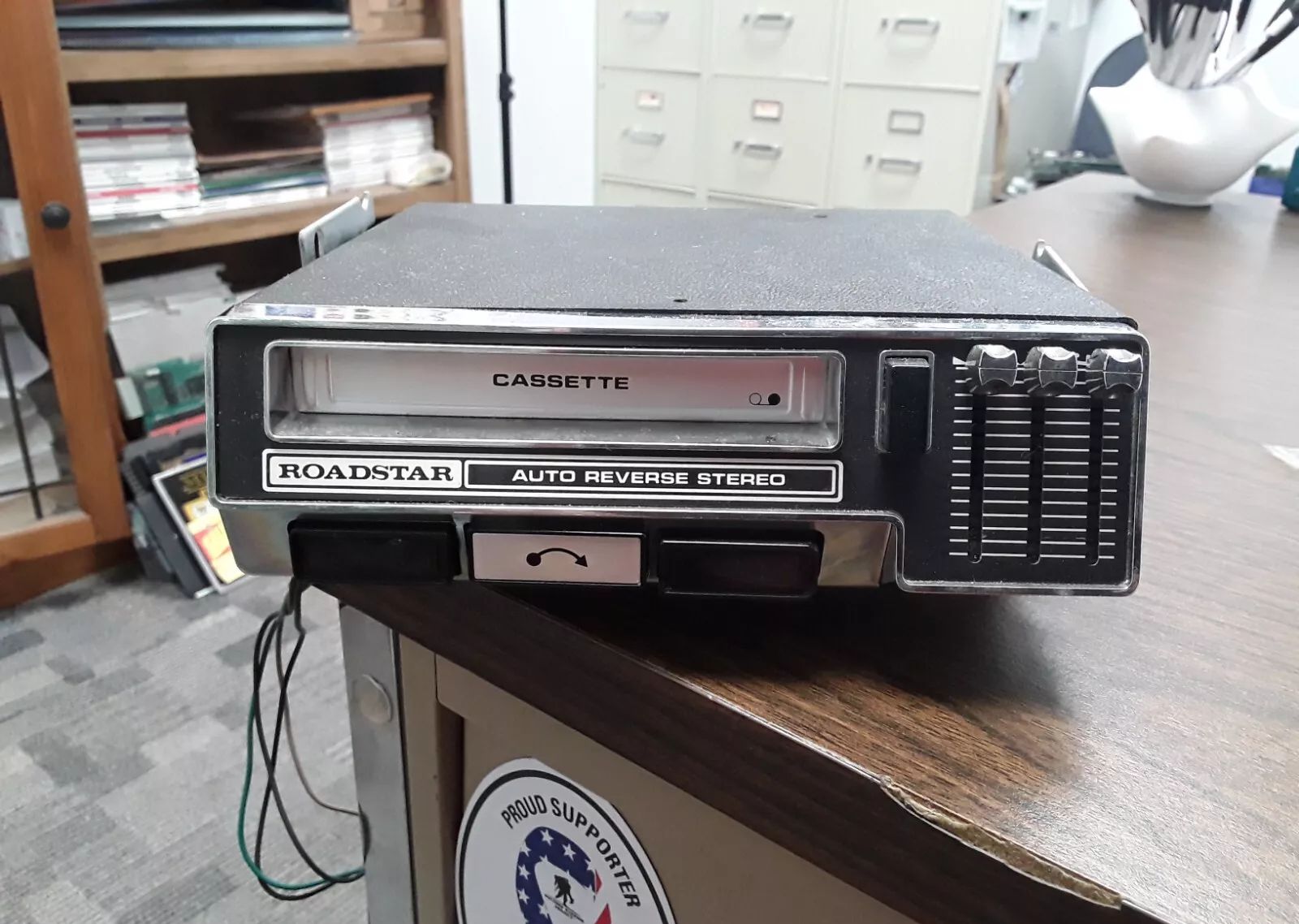
A tape deck was an affordable addition to an arcade machine, but the medium is very limited in its adaptability: it can basically run a loop and its output be mixed to the speaker output or not, depending on game state. The use of tapes was rare, but there are a few interesting examples such as the Pacific Novelty games mentioned below.
Early arcade game developers wanted different types of sound:
- Sounds that would attract players to the machine, such as musical jingles or voices
- Sound effects as feedback for player and opponent actions. The realism of these sounds were at times less important than how 'punchy' and cool they sounded.
- Background music or talking voices to keep the player as engaged as possible.
These sounds are in 3 broad categories:
- Sound effects
- Voices
- Music
Ambience was a bit more rare for arcade games, probably because the subtle background sound would be drowned out in a typically loud arcade setting. There were exceptions, of course, such as 'Carnival' and 'Two Tigers', mentioned below.
Since sound effects weren't always focused on realism, they could be created using synthesized sounds, which were very flexible and relatively inexpensive.
Music could be played from tape, but it was way more common to also synthesize the music, using the same or similar hardware to what was used for sound effects.
Before the 1980s, voices could only be played from tape. Sampled voice was too expensive due to memory cost, and voice synthesis were still in its infancy. Only in the early 1980s, speech chips, such as the Texas Instruments TMS 5xx0 chips, famously used in the 1978 Speak & Spell, would be able to crudely replicate speech using Linear Predictive Coding (LPC).
In the next section, we will look at some key examples of sound and music in arcade games from the 1971-1984, and the audio technology that made it possible.
Early Experiments in Game Sound
In the following, we go through some interesting examples of early video game sound, and picking out a few video game audio 'firsts', including the first publically available video game (which does have sound), the first video game with music, an early example of atmospheric sound, very early examples of real-time software synthesis, and the use of dynamically mixed tape loops for voices.
Computer Space, The First Video Arcade Game
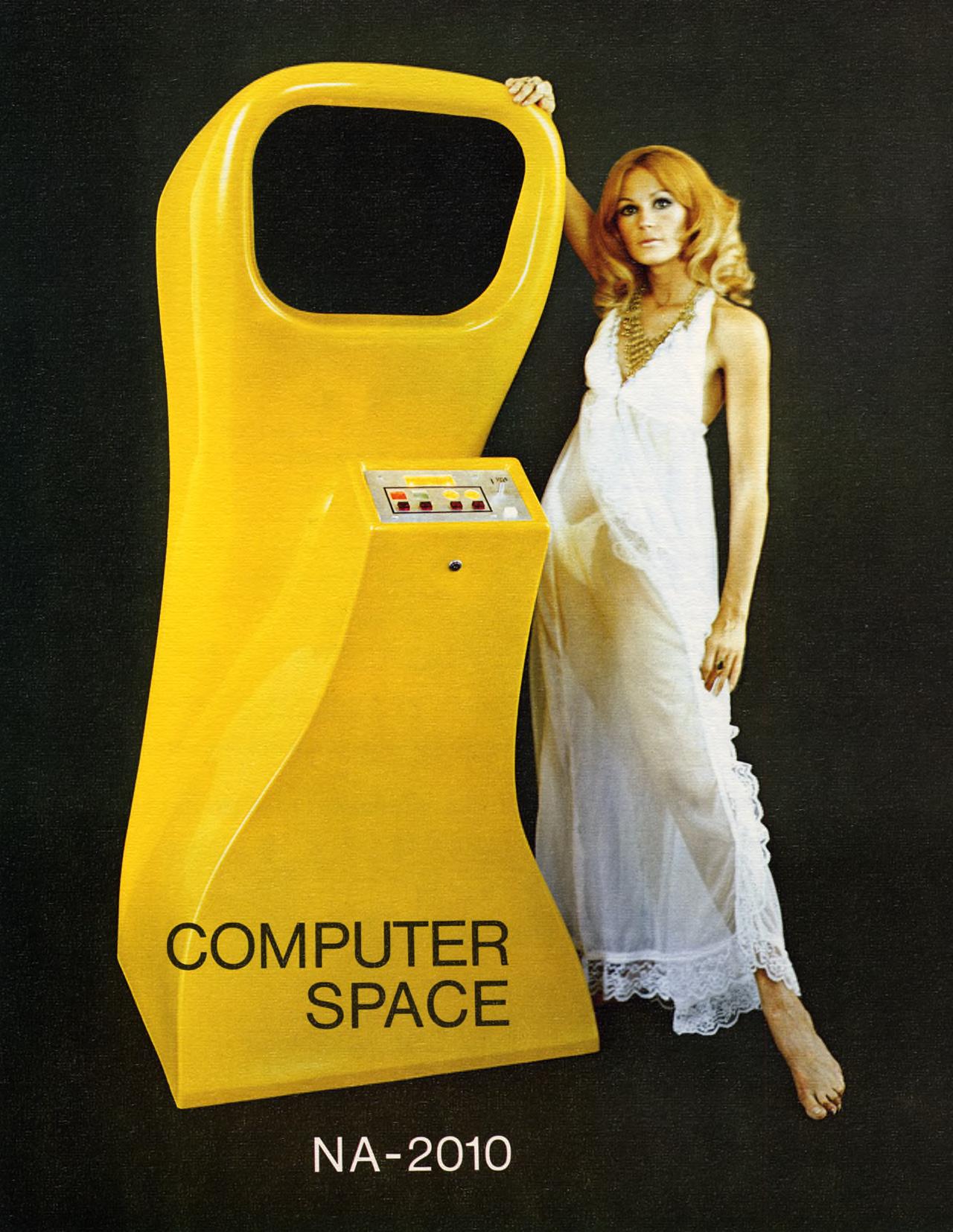
Computer Space from 1971 was the first arcade video game, created by Syzygy Engineerings, later known as Atari. You control a rocket ship and fire remote-controlled missiles to fight against enemy flying saucers (who also fire back). You move by rotating your ship and fire your rocket to fly forward. To stop, you need to reverse your momentum by turning the ship around and fire the rocket in the opposite direction. The gameplay is similar to Asteroids.
It has synthesized sound4 made from noise and shrill beeps. Rotating your rocket ship is accompanied by the aforementioned beeps (which seems mostly like gameplay feedback, less than representing any physical phenomenon). Firing the rocket to go forward is accompanied by white noise. Firing a remote-controlled missile has a beeping sound while the missile is active. Finally, explosions are accompanied by loud booms, which sounds like distorted square waves.5
The game really sounds mysterious and futuristic for its time.
Gun Fight and Music
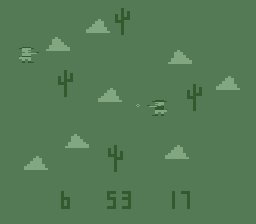
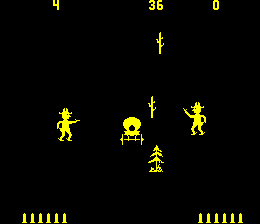
The first video game with music that I managed to find is Gun Fight from 1975. The original game, named 'Western Gun', was designed using discrete logic components by Tomohiro Nishikado, creator of Space Invaders, but was reimplemented for the US market by Midway using an Intel 8080 CPU. This made it the first arcade game to use a microprocessor. Both versions simulates a western shootout between two human characters (the first of its kind), but the sound is different: Western Gun has little footstep sounds and gunshots that sound like gated noise. The Midway version is quite different. The footsteps are gone, gunshots and hits are stereo, and when a character gets killed, it plays the funeral march melody from Chopin's Piano Sonata no. 2 using a square wave oscillator.
The Atmosphere of Carnival
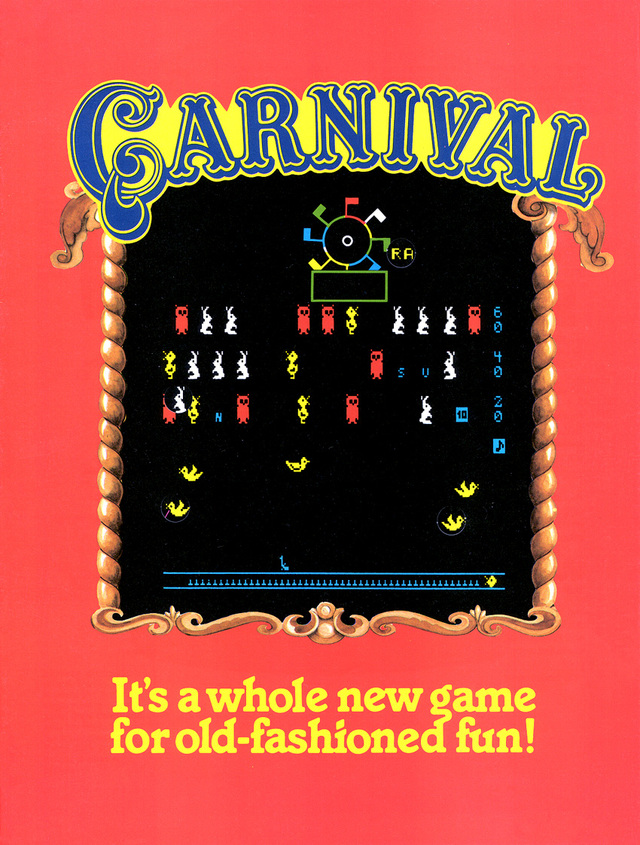
Carnival (Sega, 1980) is notable in video game audio history for being a very early game that carefully replicates a real-world setting in audio, namely the busy atmosphere of a carnival shooting gallery. Shooting sounds, birds chirping, and a very realistic bell sound when you hit a target are essential gameplay feedback sounds, all accompanied by the classic carnival theme song 'Sobre las Olas'. Every sound is synthesized, using a custom sound board made from discrete components (as opposed to components integrated in a chip). 6
Defender and Realtime Synthesis
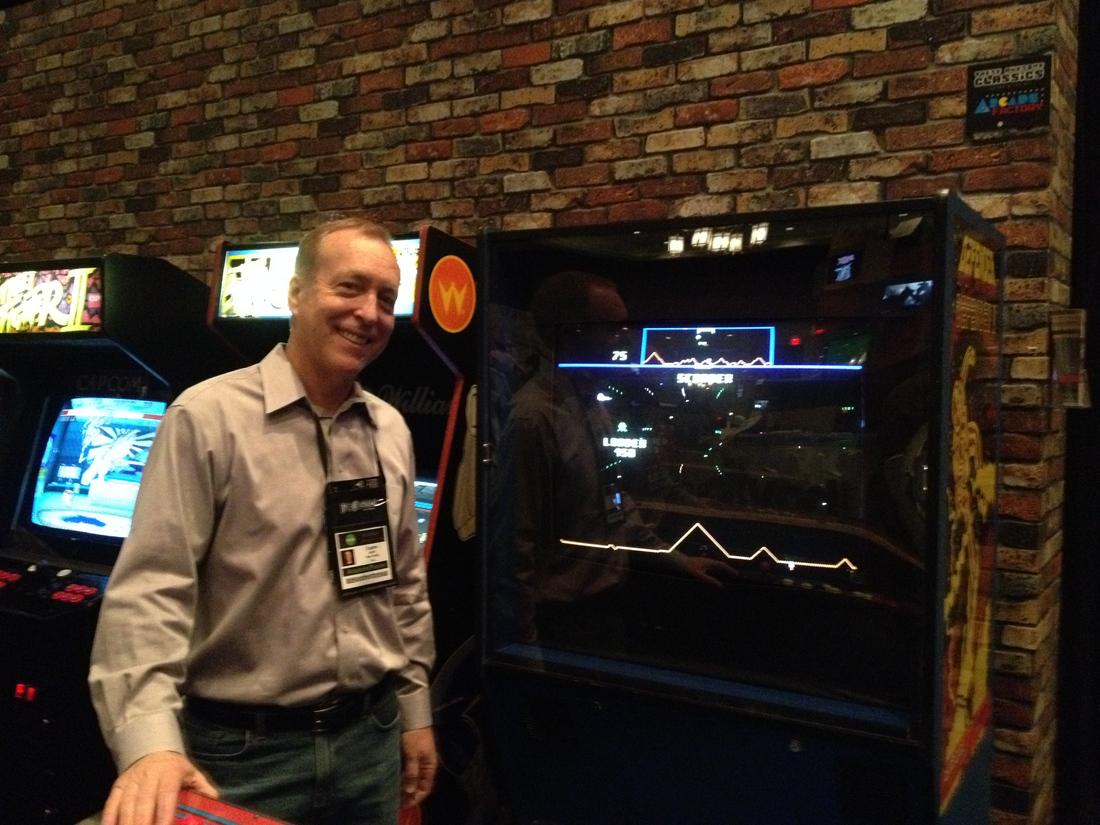
The intense scrolling shoot 'em up Defender from 1980 was not immediately a hit due to its high difficulty and complicated controls. However, the visuals and audio of this game has to be seen to be believed - it is an assault on your senses, with constant color cycling, extremely fast scrolling, constant laser beams and explosions, and brutal sound with searing lasers, booming explosions, and creepy alien voices. Listening to this game quickly leaves you confused with regards to which audio hardware it uses: it doesn't sound like creative use of simple oscillators or an early use of samples.
The reason why it sounds unique is because it uses a rare technique: Defender's sound effects are all generated in realtime by a custom Motorola 6802-based sound card. This sound card has its own 2 KB ROM with a library of software synthesis routines that play sound by directly outputting 8-bit samples to a digital-analog converter (DAC). The synthesis routines are triggered from the game, and the system only supports playing one sound at a time, although sounds can interrupt each other instantly.8
Outside of Williams, the approach of software synthesis was quite rare, early on possibly due to CPU constraints, and later on the existence of dedicated hardware synthesis chips. The audio system was developed by Eugene Jarvis for pinball table Laser Ball (1979), and was also used in Robotron: 2084.
Pacific Novelty and Tape Sound
Pacific Novelty created two arcade games in 1981, Thief and Shark Attack. These games were indeed novelties, because they both use magnetic tape loops for playing back voices.
In car-based maze game Thief, sound effects are generated using a AY-3-8910 dedicated sound chip, mixed with a constant tape loop of police radio chatter, that adds an overall atmosphere and urgency to the Pac-man style gameplay.9 However, the tape loop is mostly constant, only muted during explosions and when gameplay is paused, so it doesn't feel very connected to the action on screen.10 Another tape loop is playing a constant loop of car crash sounds, which is muted until you crash, and then unmuted for a short while. Obviously, the synchronization of this method isn't so great, but the game sacrifices synchronization for realistic sounds.
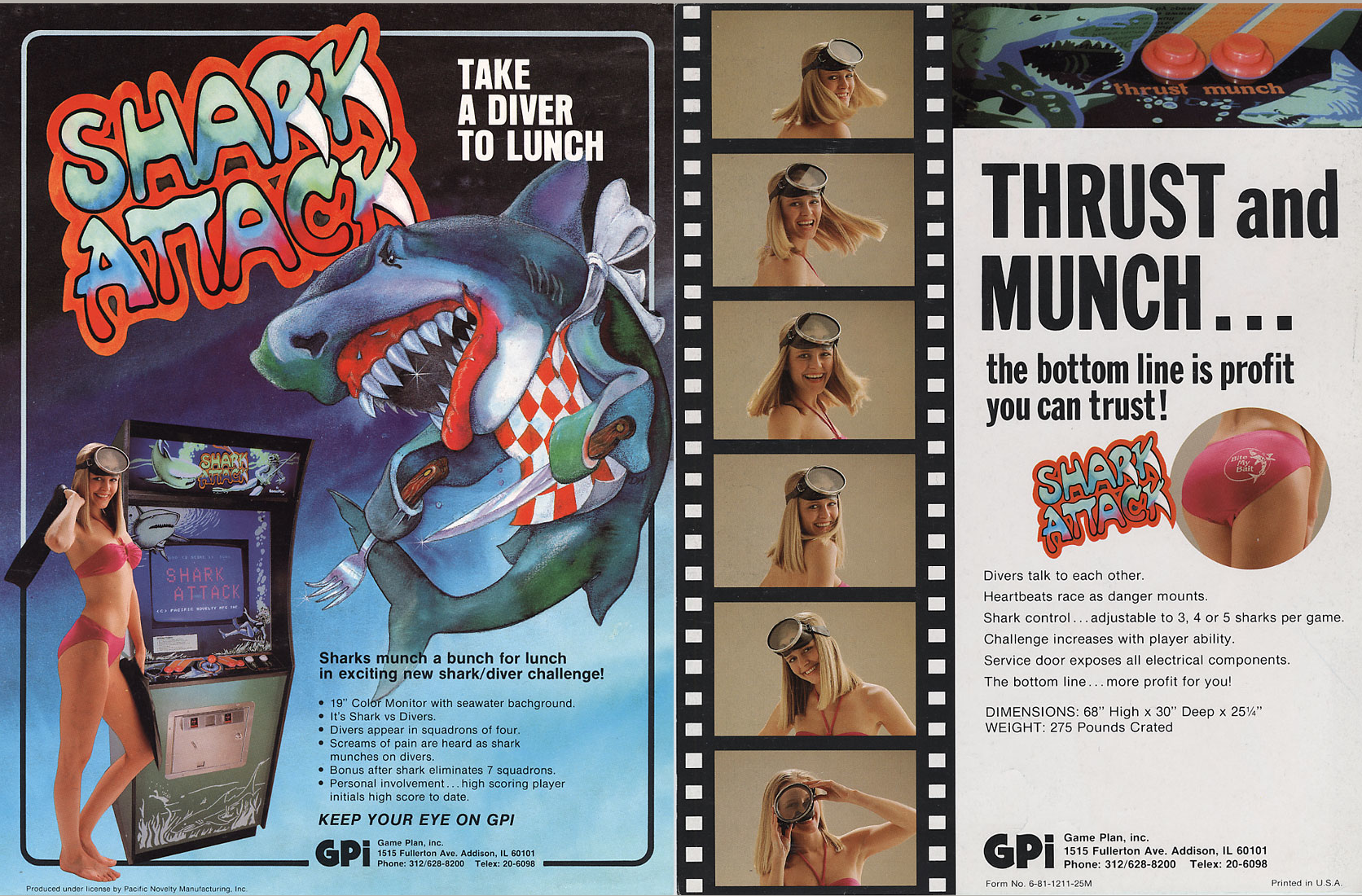
Shark Attack also generates sound effects using the AY-3-8910, and it uses two tape loops to better effect than Thief although the result sounds quite insane: The game has constant voice chatter from a group of divers that are being hunted by a shark, controlled by the player. 11 Whenever a person gets eaten, the second tape loop is added to the mix, containing death screams. I have listened to the death scream tape, and the voice actors are really going all out - it is truly the stuff of nightmares. 12
The flyer for 'Shark Attack' states:
Screams of pain are heard as shark munches on divers
Quadraphonic four-way sound creates an environment beyond the realm of realism.
The arcade game 'Journey' from 1983 by Bally Midway played a music loop of the track 'Separate Ways' by progressive rock band Journey while you were controlling the band members in different minigames. This was an early example of prerecorded music in a video game.
The Bally Midway plane shooter 'Two Tigers' from 1984 was based on the hardware for the TRON video game. Unlike the Pacific Novelty games, it uses a tape loop to represent ambience. In this game, the tape loop has the sound of the pacific war: horrifying gunshots, explosions, plane engine sounds, sirens, and screams.13
Music Technology
Music in Games: CPU Required?
The first video game to use music was Midway's 'Gun Fight', and it's notable that this is also the first game based on a CPU. We can speculate that arcade game developers felt that music was too tricky to create without a CPU, without being able to write the music in software.
The arcade games used custom discrete circuit boards to play the sound. The sound generation would have to be designed into the hardware. This approach didn't last long, however, as General Instruments introduced the AY-3-8910 chip in 1978, a 3-voice Programmable Sound Generator (PSG), and other chip designers such as Yamaha would create a wealth of synthesizer chips especially designed for games in the 1980s.
In games using these dedicated sound chips such as Frogger, music and sound would often be implemented by sending control signals to control frequency and amplitude of digitally controlled hardware oscillators that would play simple tones in response. This approach to music we will call note-based. This is similar to how MIDI music works (although this was years before MIDI was invented). Music could be represented in program data as notes or frequency values.
In a few cases where a certain level of fidelity was required, prerecorded music could be played from tape, the most well-known example being the aforementioned 'Journey' from 1983.
The CPU-based realtime synthesis of Defender was a third approach to sound, but this wasn't used for music until years later. Unwittingly, British electronics company Sinclar Resarch would provide a testing ground for experiments with realtime synthesis in the 1980s, by releasing the succesful ZX Spectrum home computer without any audio hardware except a single oscillator connected to a speaker without any way of modifying waveform or amplitude (similar to the beeper of the Apple II). This frustrating audio hardware led brilliant programmers like Tim Follin to create a genre of realtime synthesized music now referred to as 1-bit music. More on this later.
We can now identify three ways of creating video game music:
- Note-based music playback
- Prerecorded music
- Realtime synthesis
At the time of writing, 50 years after 'Gun Fight' was released, game music is currently mostly using prerecorded music, in the form of digtally sampled music. Games trigger playback of prerecorded stems (music clips that can be pieced together to form a complete soundtrack) or compressed streams, functionally equivalent to the cassette tape systems of the past, but incredibly flexible, with the ability to instantly switch sounds, and to layer many sounds on top of each other. It seems clear that this evolution hass been driven by cheap storage solutions, both hard disks and optical media, as well as plentiful amounts of memory being available for sampled audio.
Note-based music and realtime synthesis is currently relegated to a small number of experimental games. The common knowledge in the game music field is that these approaches are too CPU intensive to be practical. It can be hypothesized that this approach will become more prevalent in the future, as CPU speeds keep increasing, and a few games such as Fract.OSC (2014), Sim Cell (2013), and Cocoon (2023) show that it is indeed possible with current hardware.
Game List
This table summarizes the early example games:
| Game | Developer | Year | Sound Hardware | Sound Elements |
|---|---|---|---|---|
| Sky Raider | United | 1958 | Electro-mechanical | SFX/gameplay feedback |
| Computer Space | Syzygy | 1971 | Unknown | SFX/gameplay feedback |
| Defender | Williams | 1980 | CPU-based realtime synthesis | SFX |
| Carnival | Sega | 1980 | Custom discrete circuit board | Ambience/SFX/Music |
| Thief | Pacific Novelty | 1981 | AY-3-8910 and cassette tape | Voice/SFX |
| Shark Attack | Pacific Novelty | 1981 | AY-3-8910 and cassette tape | Voice/SFX |
| Two Tigers | Bally Midway | 1984 | Z80, 2xAY-3-8910, 8-track cassette14 | Ambience/SFX |
In the following section, we will look at a particular class of game soundtracks, namely adaptive music.
Changelog
- 2025-12-11 Split game audio history section from adaptive music article
- 2025-02-16 Edited history section
- 2025-02-08 Added history section about sound and music in early games, recorded and synthesized sounds.
- 2025-02-05 Added section about sound and music in early games, and Space Invaders calculations as footnotes.
- 2024-12-16 Added details about Xenon and other games, edited structure
- 2024-12-12 Added figures
- 2024-11-04 Collecting notes about adaptive and generative music
- 2024-12-02 Extracted Generative music article from tag description
- 2024-12-04 Joined articles about adaptive and generative music
References
-
1958 Sky Raider
channel: Spanky Isageek
YouTube ↩ -
1977 would see the release of two groundbreaking devices: The Atari 2600 console and the Apple II computer, both platforms being home to now classic video games that would influence the rest of game history. The Television Interface Adaptor (TIA) was responsible for the sound output of the incredibly popular Atari 2600, and it would provide it with a mere 2 channels of mono sound with limited control of volume and frequency, and a selection between fixed waveforms. The Apple II computer was much less capable. It had a 1-bit speaker that could produce a single click, when you triggered it. You could multiple clicks in quick succession to generate pitched sounds, but this was already a quite advanced technique. ↩
-
Thief by Pacific Novelty Video Arcade Game Cassette Player-WORKING!
Pinball Shoppe
Ebay ↩ -
The Early Evolution of Sound and Music in Video Games: 1971-1984
Reddit user Typo_of_the_Dad
Reddit ↩ -
Original Nutting Associates Computer Space (1971) gameplay
andys-arcade 2017
YouTube ↩ -
Carnival Owner's Manual
Gremlin/Sega 1980
Arcade Museum ↩ -
Defender: an all-time classic that still offers lessons today
Colin Campbell 2014
Polygon ↩ -
Nameless Algorithm: Defender Hardware
Nameless Algorithm (2015)
Blog posts on namelessalgorithm.com ↩ -
Owners Manual for Thief
Pacific Novelty Manufacturing 1981
Arcade Museum ↩ -
Arcade Game: Thief (1981 Pacific Novelty)
channel: Old Classic Retro Gaming
YouTube ↩ -
Owners Manual for Shark Attack
Pacific Novelty Manufacturing 1981
Arcade Museum ↩ -
Arcade Game: Shark Attack (1980 Pacific Novelty)
channel: Old Classic Retro Gaming
YouTube ↩ -
Bally Midway TWO TIGERS Arcade Video Game Complete 8 TRACK SOUNDTRACK! TNT Amusements
channel: TNT Amusements Inc
Todd Tuckey 2014
YouTube ↩ -
Two Tigers
Pixelated Arcade ↩